Table of Contents
Introduction
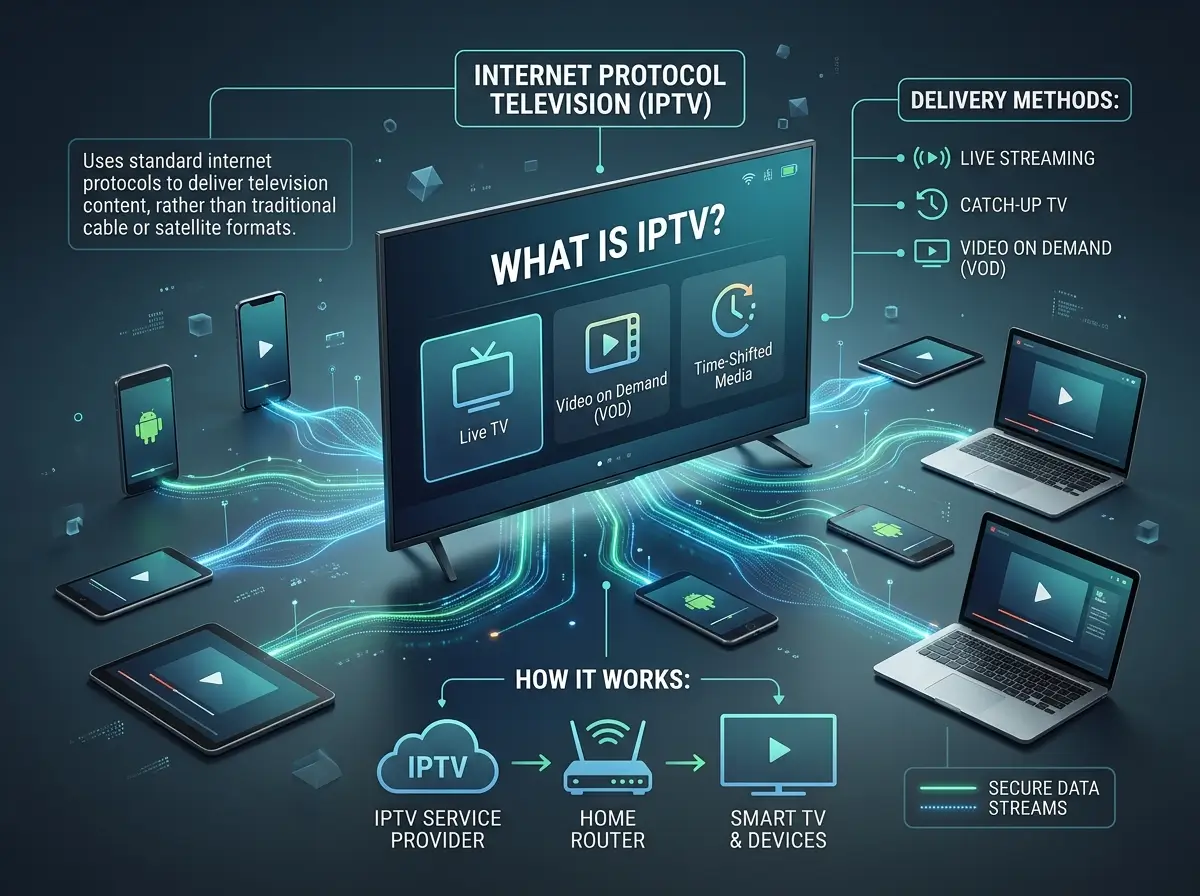
What is IPTV? It is a question asked by millions of people every year — and the answer is simpler than most expect. IPTV stands for Internet Protocol Television, and it refers to the delivery of television content over a broadband internet connection rather than through traditional broadcast methods like satellite, cable, or aerial signals.
If you have ever streamed a film on a video platform or watched a catch-up service through a smart TV app, you have already experienced a form of what is-IPTV in practice. The principle is the same: content delivered over the internet, on demand, to the device of your choice.
What sets IPTV apart from general video streaming is scope. A full IPTV service replaces your entire television setup — providing hundreds of live channels, a complete programme guide, on-demand content, and catch-up functionality, all through a single subscription and a compatible app.
This guide answers the question of what is IPTV thoroughly — covering how it works, what it is used for, how it compares to traditional TV, and everything else a first-time reader needs to understand.
What Is IPTV? The Simple Explanation
What is IPTV in plain terms? IPTV — Internet Protocol Television — is a system for delivering television content using internet data protocols rather than conventional broadcast infrastructure. Where traditional television transmits signals via satellite, cable network, or terrestrial aerial, IPTV sends the same content as a stream of internet data packets directly to a compatible device.
The result, from the viewer’s perspective, is television that works through an app rather than through a set-top box or aerial connection. A viewer using an IPTV service selects a channel, and the content is streamed in real time from the provider’s servers to their screen — in exactly the same way that music streaming sends audio or video streaming sends films.
What is IPTV in terms of what it includes? A comprehensive IPTV service typically provides:
- Live channels — hundreds of channels spanning entertainment, news, sport, children’s content, lifestyle, and international programming, broadcast in real time
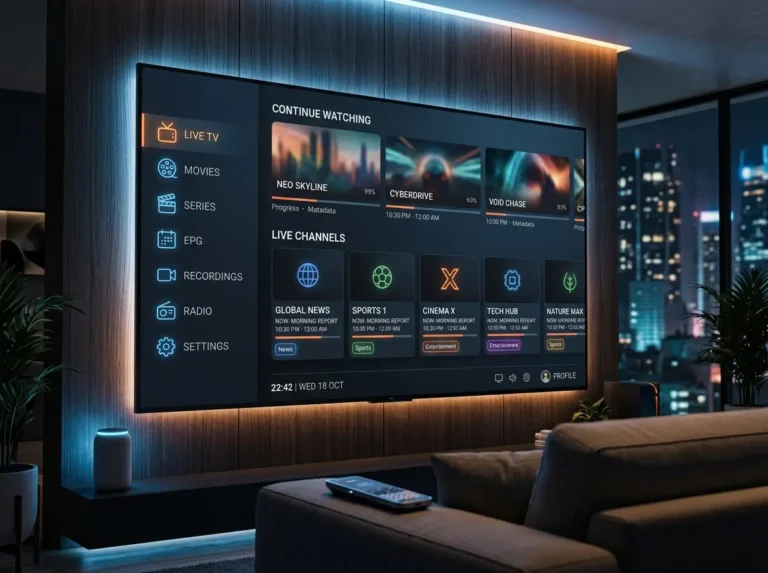
- Electronic Programme Guide (EPG) — a built-in TV guide showing current and upcoming programming across all available channels
- Video on Demand (VOD) — an on-demand library of films, series, and documentaries available to watch at any time
- Catch-up TV — the ability to rewatch content broadcast within the previous 24 to 72 hours
What is IPTV in terms of device compatibility? An IPTV service works across smart TVs, Amazon Fire Stick, Android TV boxes, Apple TV, smartphones, tablets, and computers — making it accessible on virtually every screen in the modern home.
How Does IPTV Work?
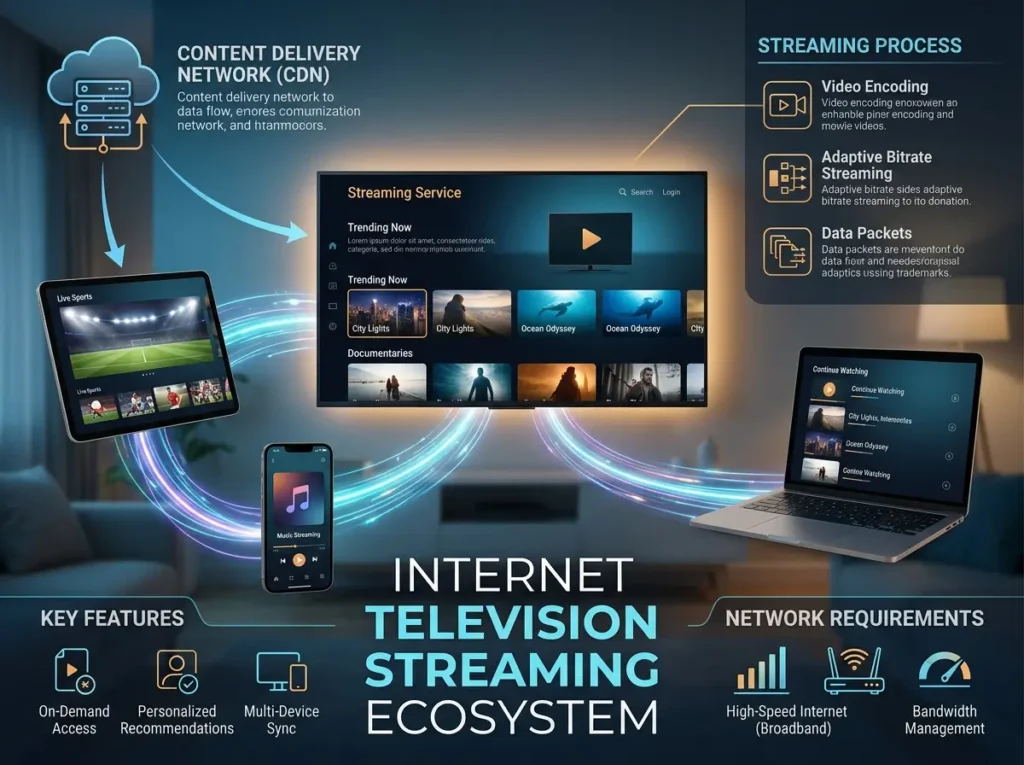
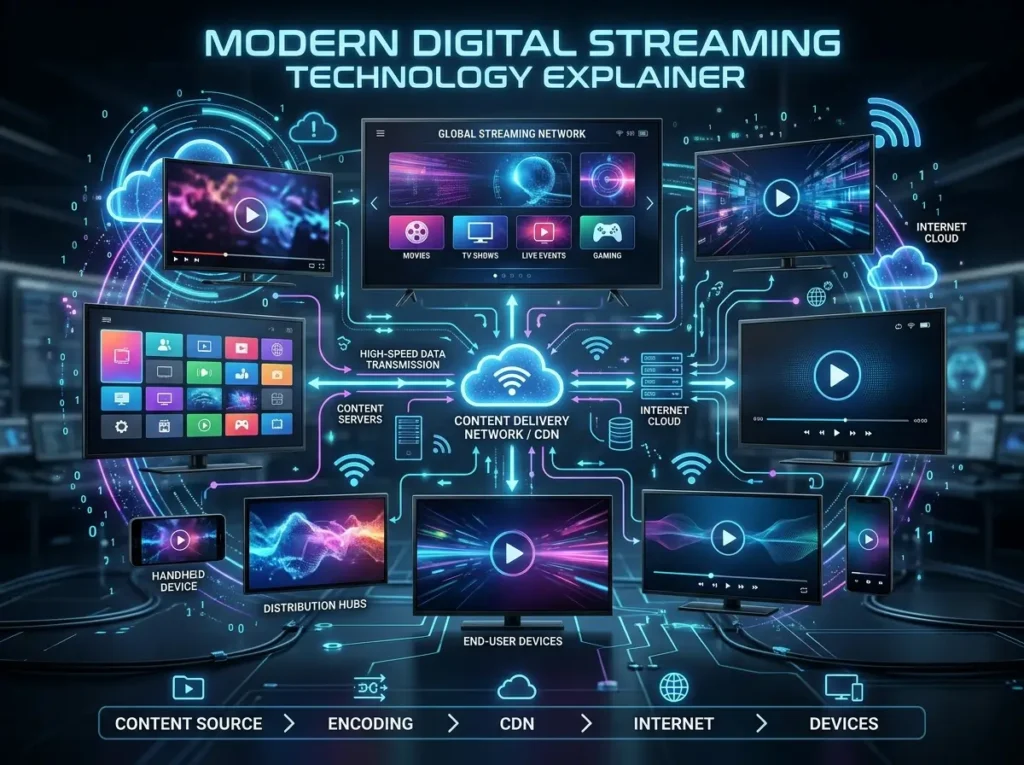
Understanding what is IPTV becomes clearer when you understand the technology behind it. The process involves three core components: the content source, the delivery network, and the receiving device.
The content source. An IPTV provider acquires broadcast rights to channels and content, then encodes that content as a digital video stream. Live broadcasts are encoded and distributed in real time; on-demand content is stored on servers and made available for retrieval at any time.
The delivery network. Rather than transmitting content via satellite signals or cable infrastructure, what is IPTV relies on internet data networks. Content travels as compressed digital packets across broadband infrastructure — the same networks used for web browsing, email, and file downloads — and is routed to the viewer’s device via their internet connection.
The receiving device. On the viewer’s end, a compatible app or media player receives the incoming data packets, decodes them, and renders the video and audio on screen. This is the role played by applications such as IPTV Smarters Pro, TiviMate, or a provider’s own dedicated app.
What is IPTV in terms of technical requirements? A broadband connection of at least 10 Mbps is recommended for HD viewing. For 4K streams or multiple simultaneous screens, 25 Mbps or higher is advisable. Most modern UK fibre broadband connections comfortably exceed both thresholds.
What Is IPTV Used For? Key Use Cases
What is IPTV used for in practice? The answer covers a broad range of viewing scenarios that collectively explain why IPTV adoption has grown so rapidly.
Replacing traditional pay-TV. The most common use case for what is IPTV is as a complete replacement for satellite or cable television. A comprehensive IPTV subscription provides everything a traditional pay-TV package offers — live channels, sports coverage, news, children’s content, and on-demand libraries — without the installation requirements, hardware costs, or long-term contracts.
Watching live sport. What is IPTV for sports fans? It is a way to access live sporting events across a broad range of sports channels, often at a significantly lower cost than dedicated sports broadcasting packages. Live sport is one of the primary drivers of IPTV adoption worldwide.
Accessing international content. What-is IPTV for international viewers and expat communities? It is a practical way to access programming from home countries and regions, with many IPTV services offering extensive international channel packages covering dozens of languages and regions.
Multi-device household viewing. What is-IPTV for larger households? It is a single subscription that supports simultaneous viewing on multiple screens — smart TV, tablet, mobile, and laptop — allowing different family members to watch different content at the same time.
Flexible, on-demand viewing. What is-IPTV for viewers who cannot plan around broadcast schedules? It is a catch-up and on-demand system that lets viewers watch content whenever it suits them, rather than being tied to fixed transmission times.
What Is IPTV vs Traditional TV? A Clear Comparison
One of the clearest ways to understand what is IPTV is to compare it directly with the traditional television options it is replacing.
Delivery method. Traditional TV — whether satellite, cable, or aerial — transmits content as a broadcast signal received by specific hardware. What is IPTV is a fundamentally different delivery model: content travels as internet data to any compatible app on any connected device.
Hardware requirements. Traditional TV requires specific reception hardware — a satellite dish, cable connection, or aerial — along with a compatible set-top box or TV tuner. What is-IPTV requires only a broadband connection and a compatible device. No installation, no specialist hardware, no engineer visits.
Contract terms. Traditional pay-TV typically involves 12- to 24-month minimum contracts with cancellation penalties. What is-IPTV services are most commonly available on rolling monthly plans with no long-term commitment.
Cost. What is IPTV in terms of value? A comprehensive IPTV subscription consistently delivers broader channel access at a lower monthly price than a comparable traditional pay-TV package — with no additional hardware or installation fees.
Flexibility. Traditional TV is fixed to the screen connected to the reception hardware. What is IPTV is device-agnostic — the same subscription works on any compatible screen, at home or on the move.
Channel access. What is IPTV in terms of content breadth? A well-configured IPTV service typically provides access to a significantly broader range of channels — including international content — than a standard traditional pay-TV package at the same price point.
What Is IPTV in Terms of Legality?
What is IPTV from a legal standpoint? The answer depends entirely on the provider.
IPTV as a technology is completely legal. The internet protocol delivery method used by what is IPTV is the same technology that underpins mainstream streaming platforms and catch-up services worldwide. There is nothing inherently unlawful about receiving television content over a broadband connection.
What determines the legality of a specific IPTV service is whether the provider holds appropriate content licences for the channels and content they distribute. A legitimate IPTV provider operates with the necessary broadcasting rights, pays the appropriate licencing fees, and complies with applicable regulations in the regions where they operate.
What is IPTV when it comes from an unlicensed provider? It is a service that distributes content without the rights to do so — which raises both legal and practical concerns for subscribers. Unlicensed services are more prone to sudden shutdowns, inconsistent performance, and the risks that come with any unregulated operation.
The straightforward guidance for anyone asking what is IPTV and whether they should subscribe: use only providers that hold appropriate content licences and operate in compliance with applicable broadcasting regulations in your region. Legitimate IPTV services are widely available, competitively priced, and fully above board.
What Is IPTV Equipment and Setup?
What is IPTV in terms of the equipment and setup required? One of the most appealing aspects of the answer is how minimal the requirements are.
A broadband internet connection. What is IPTV without a reliable internet connection? Unusable. A minimum of 10 Mbps is recommended for HD viewing; 25 Mbps or higher for 4K or multi-device households. Most modern broadband packages comfortably exceed these thresholds.
A compatible device. What is IPTV compatible with? Smart TVs, Amazon Fire Stick, Android TV boxes, Apple TV, iOS and Android smartphones, tablets, and Windows computers. If a device has an app store and an internet connection, it almost certainly supports IPTV.
An IPTV player app. What is IPTV accessed through? A media player application — either a provider’s own dedicated app or a third-party player such as IPTV Smarters Pro or TiviMate — installed on the chosen device.
An active IPTV subscription. What is IPTV without a subscription? Just an empty app. A paid subscription from a quality provider supplies the credentials — typically a server URL, username, and password, or an M3U playlist URL — that unlock the full channel list, EPG, and VOD library.
Setup from first download to first stream typically takes under 15 minutes. What is IPTV in terms of technical difficulty? For most users, it is no more complex than setting up any other streaming app.
What Is IPTV — Frequently Asked Questions
What is IPTV in simple terms? IPTV — Internet Protocol Television — is a system that delivers television channels and on-demand content over a broadband internet connection rather than through traditional satellite, cable, or aerial broadcast infrastructure.
What is IPTV used for? IPTV is used to watch live television channels, sports, international content, and on-demand programming across multiple devices — as a flexible, affordable alternative to traditional pay-TV packages.
What is IPTV and is it legal? IPTV technology is legal. The legality of a specific service depends on whether the provider holds appropriate content licences. Always subscribe to providers that operate in compliance with applicable broadcasting regulations.
What is IPTV equipment needed? A broadband connection, a compatible device (smart TV, streaming stick, smartphone, tablet, or computer), an IPTV player app, and an active subscription from a quality provider.
What is IPTV picture quality like? Quality IPTV services deliver HD streams as standard, with 4K available on supported channels and devices. Picture quality depends on both the provider’s infrastructure and the viewer’s broadband speed.
What is IPTV subscription cost? Pricing varies by provider and plan type. Monthly rolling IPTV subscriptions are typically priced competitively against — and often significantly below — comparable traditional pay-TV packages.
Conclusion: Now You Know What Is IPTV — Here Is What to Do Next
What is IPTV? It is internet-delivered television — flexible, device-agnostic, affordable, and increasingly the default choice for households moving away from traditional broadcast television. The technology is mature, the best services are genuinely impressive, and the setup is straightforward for virtually any viewer.
What is IPTV for your household specifically depends on what you watch, which devices you own, and what you currently pay for television. For most viewers, the answer to what is IPTV becomes obvious quickly: it is a better way to watch TV, at a lower cost, on any screen you choose.
Explore your options, start with a trial from a licensed provider, and discover what IPTV can do for your viewing experience.